
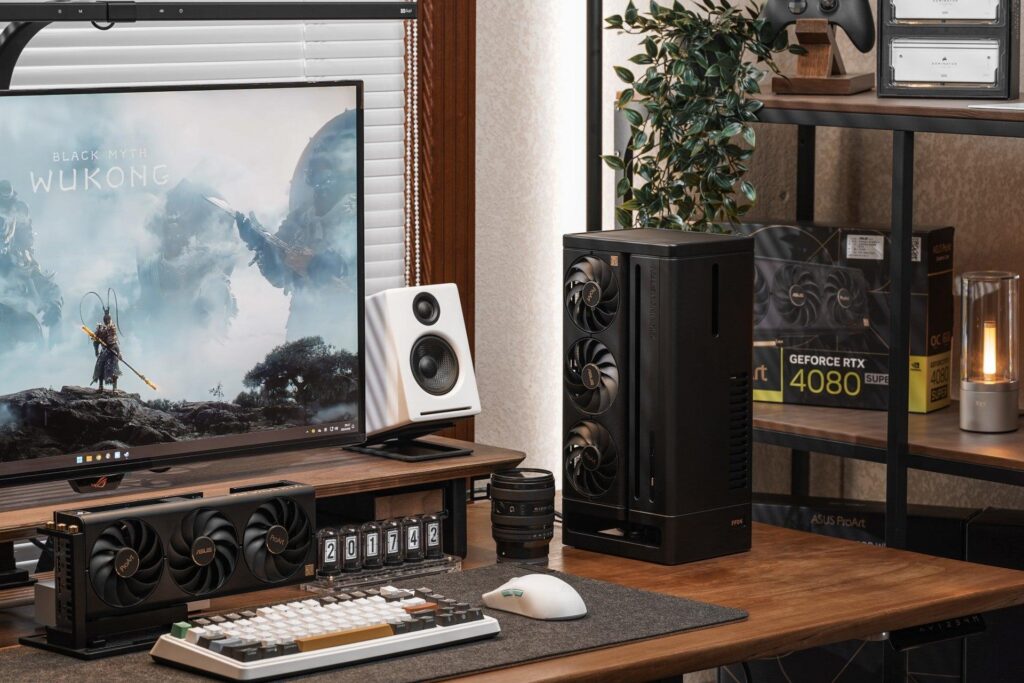
A discounted RTX 4080 Super can still make a very convincing case in 2026: it has 16GB of GDDR6X memory, excellent 4K raster performance, and NVIDIA’s mature DLSS ecosystem. But it is no longer automatically the sensible high-end purchase. Your monitor, the street price, and whether you value newer AI features matter far more than the badge on the box. Here’s where the 4080 Super remains genuinely strong, and where you should hesitate.
RTX 4080 Super Specs, Price, And Positioning
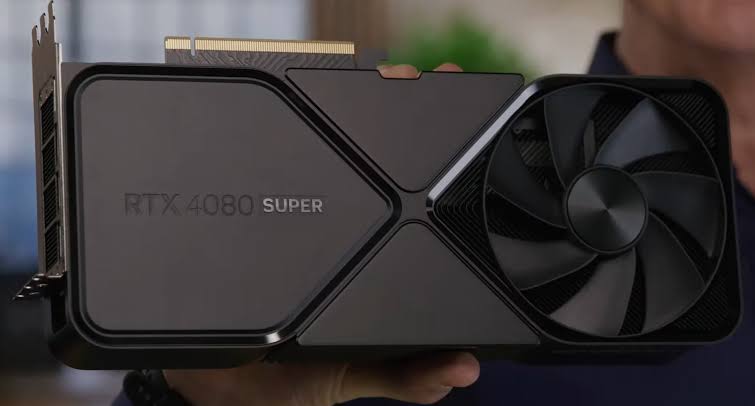
The GeForce RTX 4080 Super arrived in January 2024 as NVIDIA’s correction to the original RTX 4080’s awkward $1,199 launch price. Its $999 MSRP immediately made more sense, even though performance gains over the non-Super model were modest.
Under the cooler is the fully enabled AD103 Ada Lovelace GPU: 10,240 CUDA cores, 80 third-generation RT cores, and 320 fourth-generation Tensor cores. The 4080 Super pairs that silicon with 16GB of 23Gbps GDDR6X memory on a 256-bit bus, delivering roughly 736GB/s of bandwidth. Reference boost clock is 2,550MHz, while board power remains 320W.
| Specification | RTX 4080 Super |
|---|---|
| Architecture | Ada Lovelace (AD103) |
| CUDA cores | 10,240 |
| Memory | 16GB GDDR6X |
| Memory bus | 256-bit |
| Total graphics power | 320W |
| Original MSRP | $999 |
In practical terms, the 4080 Super is a premium 4K card rather than a “buy it for 1080p esports” card. It is also only a few percent faster than the RTX 4080, so existing 4080 owners should not upgrade. The better comparison in 2026 is against current pricing: a used or clearance 4080 Super is attractive when it costs materially less than newer cards such as the RTX 5060 or other current-generation GPUs offering similar value.
The 16GB question is more nuanced than it sounds
Sixteen gigabytes is still workable for 4K gaming, especially with DLSS, but it is not extravagant anymore. A handful of heavily modded games, professional 3D scenes, and local AI workloads can exceed it. If your work involves large Stable Diffusion models, complex Unreal Engine assets, or 8K video timelines, VRAM capacity, not shader speed, may become your first limit.
Gaming, Ray Tracing, And AI Performance
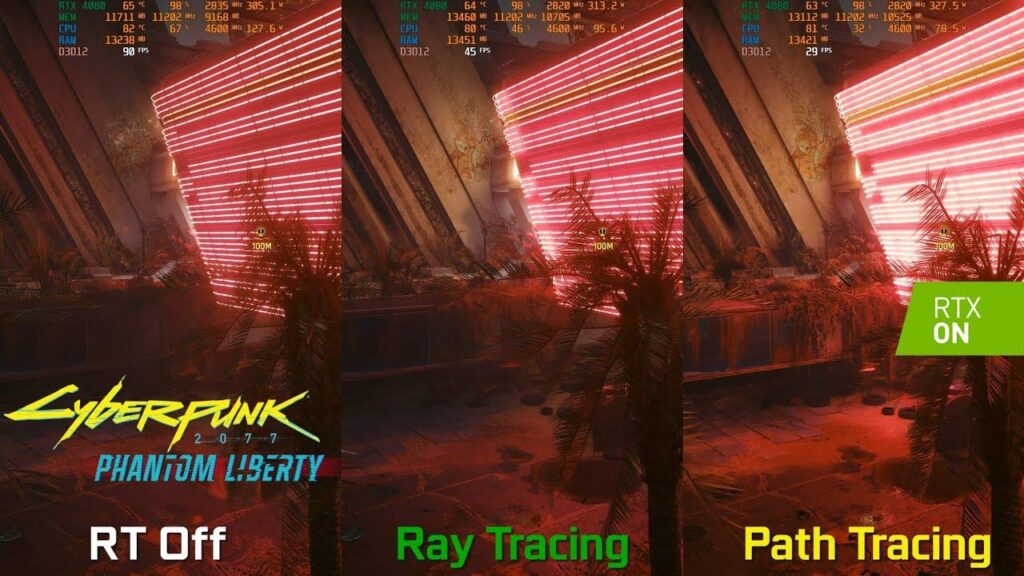
At native 4K, the 4080 Super remains fast enough to make a high-refresh 4K display feel justified. In conventional rasterized games, it is comfortably above the performance tier most players need for 60 fps at Ultra settings and can often reach far higher figures with sensible tuning. At 1440p, it can be overkill unless you own a 240Hz-plus monitor.
Ray tracing is where this GPU keeps more of its 2026 relevance. Ada’s third-generation RT cores handle demanding lighting workloads well, and NVIDIA still has the broadest support for ray-traced features across major PC releases. Games such as Cyberpunk 2077, Alan Wake 2, and Hogwarts Legacy can look dramatically better with RT enabled, but full path tracing remains punishing without upscaling.
That is why DLSS matters as much as raw hardware. DLSS Super Resolution can turn a difficult 4K workload into a seamless process, while DLSS 3 Frame Generation inserts AI-generated frames on RTX 40-series cards. The 4080 Super also supports Ray Reconstruction, which uses AI to improve denoising in supported ray-traced titles.
| Your priority | What the RTX 4080 Super does well | Watch-out |
|---|---|---|
| 4K single-player games | High settings, strong RT results | Native 4K path tracing is demanding |
| Competitive gaming | Very high 1440p frame rates | CPU limits can dominate |
| Streaming and editing | Dual AV1 encoders, CUDA acceleration | 16GB can constrain huge projects |
| Local AI experimentation | Tensor acceleration and CUDA support | Larger models favor more VRAM |
Frame Generation is not a free frame-rate coupon
Frame Generation works best when your base frame rate is already healthy, think roughly 60 fps or higher, and when you are not hypersensitive to latency. Pair it with NVIDIA Reflex in supported games. It can make a visually demanding title feel remarkably fluid, but it cannot rescue a stuttering CPU-limited game or compensate for insufficient VRAM. That distinction saves a lot of disappointing upgrade purchases.
Power, Case Fit, Cooling, And Software Features
A 320W graphics card is efficient for its performance class, but the 4080 Super is not a casual drop-in upgrade. NVIDIA recommends a 750W power supply for the Founders Edition: an 850W quality unit gives more breathing room with a power-hungry CPU, extra drives, or aggressive boost settings.
Most models use the 16-pin 12VHPWR or 12V-2×6 connector. If you use the supplied adapter, fully seat every plug and avoid sharply bending the cable immediately beside the connector. It is boring advice until it prevents a very expensive problem.
Physical clearance is equally important. Founders Edition dimensions are manageable for a flagship card, but many ASUS ROG Strix, MSI Suprim, and Gigabyte AORUS versions are long, thick, and heavy. Some occupy more than three slots. Measure from the rear PCIe bracket to front fans or radiator tubes, then check GPU thickness and connector clearance against your case manual.
A five-minute pre-purchase fit check
| Check | What to confirm |
|---|---|
| Case length | GPU length plus cable-bend room |
| Slot clearance | Three to four slots on partner cards |
| PSU | 750W minimum: 850W preferred for high-end builds |
| Power lead | Native 12V-2×6 cable if your PSU provides one |
| Airflow | Clear front intake and unobstructed GPU fans |
The RTX 4080 Super also benefits from NVIDIA’s less glamorous strengths: Game Ready and Studio drivers, CUDA application support, NVIDIA Broadcast, Reflex, G-SYNC compatibility, ShadowPlay capture, and dual AV1 encoding. For a creator who edits in Premiere Pro, DaVinci Resolve, or Blender, that software stack can be worth more than a small benchmark win from a competing GPU.
One useful ownership habit: use MSI Afterburner or NVIDIA’s app overlay to set a frame-rate cap for your display. Capping a 120Hz game around 117 fps with G-SYNC can reduce power draw, fan noise, and frame-time swings. The 4080 Super does not need to sprint at 350 fps in a menu screen to prove it is fast.
Conclusion
The RTX 4080 Super is still a capable 4K GPU in 2026, particularly for ray tracing, DLSS, CUDA creation work, and quiet high-end builds. Buy it only at a compelling discount, ideally below newer alternatives with stronger VRAM or feature sets. If the price is right, though, its combination of 16GB memory, 320W efficiency, and excellent software support remains hard to dismiss.