
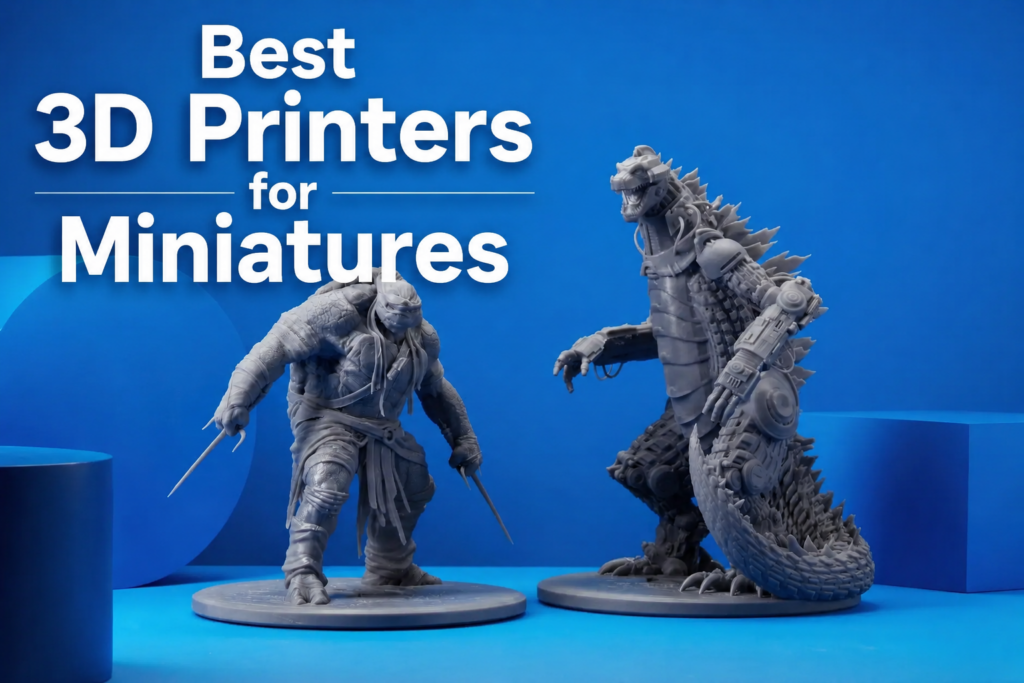
The best 3D printer for miniatures needs to deliver sharp detail, reliable print consistency, and the right build volume for your workflow. Whether you’re printing Warhammer 40K armies, D&D dungeon terrain, or competition-level display pieces, the printer you choose makes all the difference.
Resin printers dominate miniature printing thanks to resolutions ranging from 4K to 14K, producing surface details under 50 microns. FDM printers still have a place for large terrain and structural models.
We tested and researched the top options on the market right now. Here are the 7 best 3D printers for miniatures in 2026, covering every budget, skill level, and use case.
1. Elegoo Saturn 4 Ultra: Best Overall for Miniature Detail and Build Volume
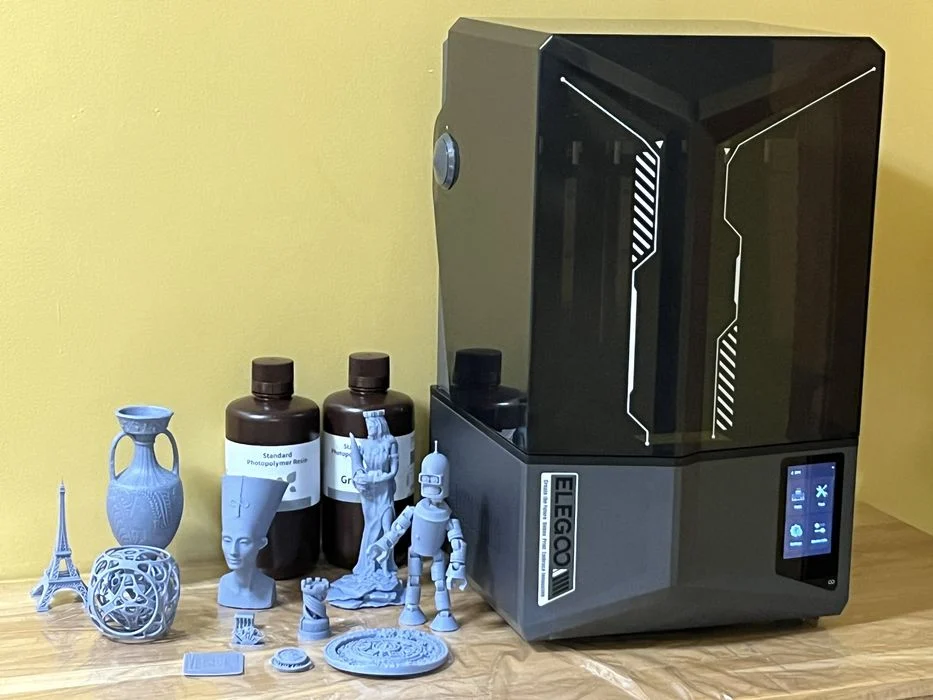
The Elegoo Saturn 4 Ultra earns the top spot on our list as the best 3D printer for miniatures overall. It combines a large 218.88 × 123.12 × 220 mm build volume with a 12K mono LCD screen, delivering exceptional layer resolution of just 19 × 24 microns per pixel.
For hobbyists who need to print full squads of 28mm tabletop figures in a single run, the Saturn 4 Ultra is hard to beat. A standard Warhammer squad of 10 infantry fits comfortably on the build plate with room to spare.
| Spec | Detail |
|---|---|
| Resolution | 12K mono LCD |
| Build Volume | 218.88 × 123.12 × 220 mm |
| XY Accuracy | 19 × 24 microns |
| Print Speed | Up to 150 mm/h |
| Price Range | ~$450–$500 |
The tilt-release mechanism reduces peel force, which significantly lowers print failures on thin spindly parts like sword blades and staff tips. UV exposure uniformity is rated at 95%+, meaning edge details are as sharp as center prints.
Who Should Buy the Saturn 4 Ultra
The Saturn 4 Ultra is the right choice for:
- Batch printers who regularly run 20+ miniatures per session
- Intermediate to advanced hobbyists moving up from smaller resin printers
- Terrain and miniature combo users who don’t want two separate machines
If you’re only occasionally printing one or two minis, the Saturn 4 Ultra’s build plate may feel oversized. But for anyone serious about volume output without sacrificing surface quality, this is the best 3D printer for miniatures at this price point.
2. Anycubic Photon Mono M7 Pro: Best Budget Resin Printer for Beginners
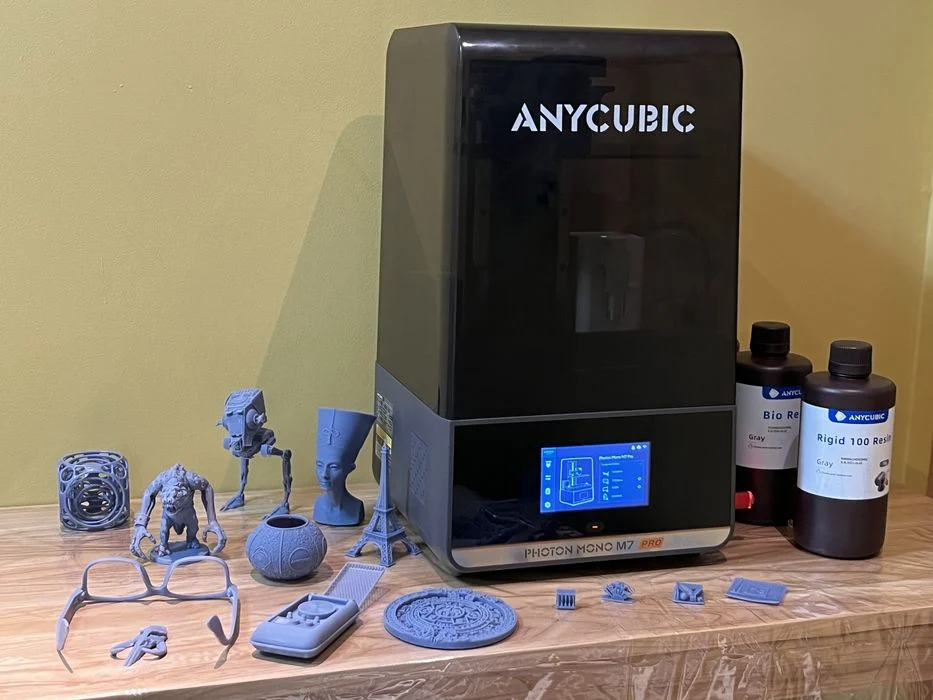
The Anycubic Photon Mono M7 Pro is the most accessible entry point into resin-based miniature printing. It builds on the well-regarded Photon M3 and M5s lineage, offering 12K resolution at a price point under $300, making it one of the most cost-effective options for beginners who want high-detail results without a steep financial commitment.
| Spec | Detail |
|---|---|
| Resolution | 12K mono LCD |
| Build Volume | 195.84 × 122.4 × 200 mm |
| XY Accuracy | 19 × 24 microns |
| Print Speed | Up to 105 mm/h |
| Price Range | ~$250–$290 |
The auto-leveling feature removes one of the most frustrating hurdles for new users, manual bed leveling. This alone reduces first-layer failures dramatically. The Anycubic slicer software is beginner-friendly, and the printer ships with a starter resin kit.
For someone printing their first D&D party of six characters, the Photon Mono M7 Pro will produce clean, well-defined facial features and weapon details at 28mm scale. It won’t match the raw output volume of the Saturn 4 Ultra, but for a first 3D printer for miniatures, the quality-to-price ratio is excellent.
The main limitation is build height, 200 mm is adequate for most humanoid figures but restricts taller terrain pieces. Resin fume management is also necessary: plan for a ventilated workspace or activated carbon filter.
3. Phrozen Sonic Mighty 8K: Best High-Resolution Pick for Competitive Painters
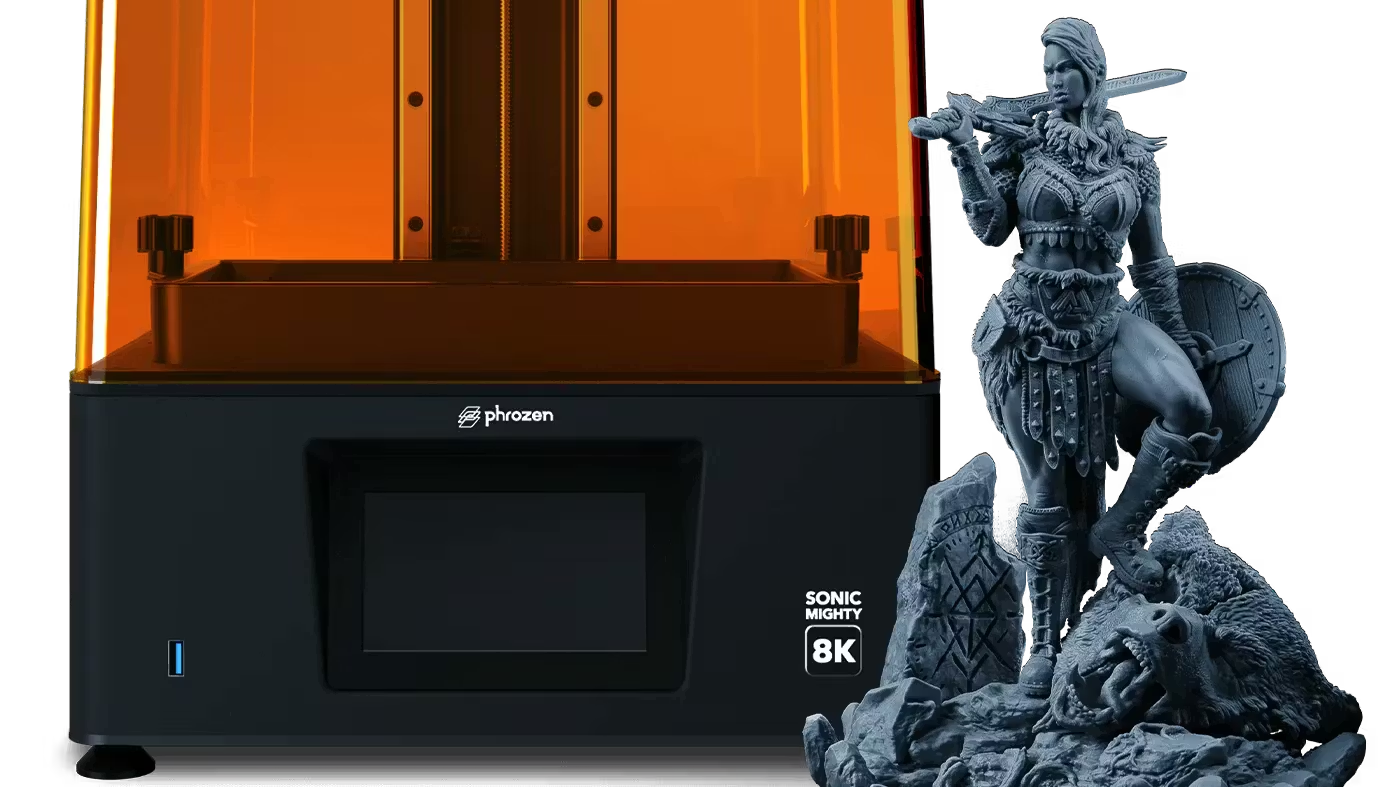
The Phrozen Sonic Mighty 8K is purpose-built for miniature painters who compete or display their work publicly. Its 8K mono LCD delivers an XY resolution of 22 × 24.7 microns, producing surface textures that standard 4K printers simply can’t replicate.
| Spec | Detail |
|---|---|
| Resolution | 8K mono LCD |
| Build Volume | 218 × 123 × 235 mm |
| XY Accuracy | 22 × 24.7 microns |
| Print Speed | Up to 80 mm/h |
| Price Range | ~$400–$450 |
Why 8K Resolution Changes the Game for Miniatures
At 28mm scale, the difference between 4K and 8K resolution is visible under a magnifying glass, and under competition judging conditions, that difference matters. Specifically:
- Chainmail rings print as individual loops rather than a textured blob
- Facial features retain defined nasolabial folds and eye socket depth
- Feathers, scales, and fur textures show individual strand separation
The Sonic Mighty 8K also has a larger build volume than most compact resin printers, allowing painters to print display-scale busts (75mm–120mm) alongside standard 28mm infantry in the same session. Custom-printed display pieces often draw inspiration from iconic franchises known for the best video game soundtracks in gaming history.
For competitive painters entering Golden Daemon, Crystal Brush, or equivalent events, print-layer lines are the enemy. The Sonic Mighty 8K minimizes those lines to near-invisible levels at 0.05 mm layer height, reducing sanding and prep time by approximately 2 hours per display piece.
4. Elegoo Mars 5 Ultra: Best Compact Resin Printer for Tight Spaces
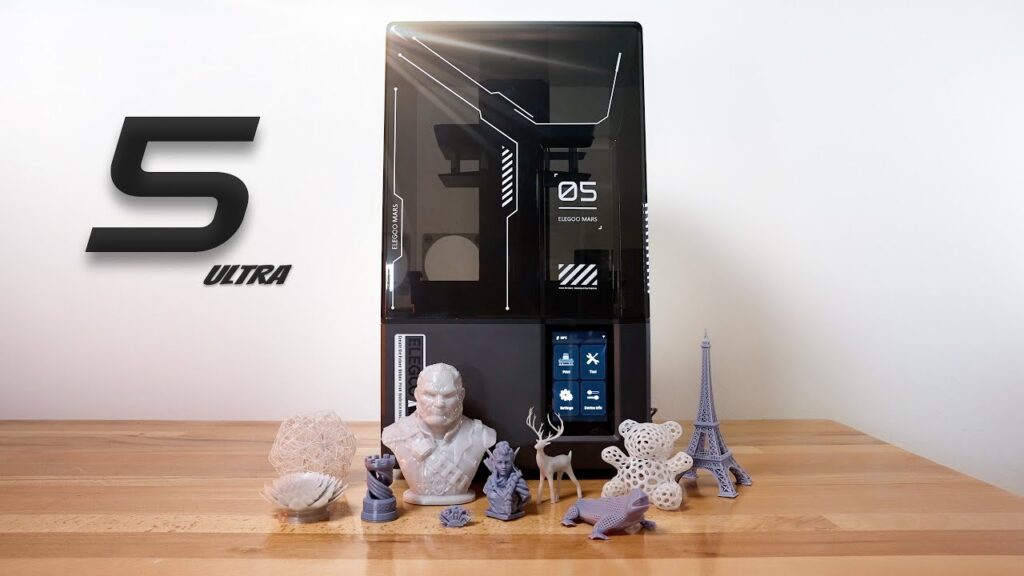
The Elegoo Mars 5 Ultra is the best 3D printer for miniatures when desk space is limited. Its footprint measures just 227 × 227 × 430 mm, roughly the size of a large coffee maker, yet it houses a 7-inch 12K mono LCD and a 153.36 × 77.76 × 165 mm build volume.
| Spec | Detail |
|---|---|
| Resolution | 12K mono LCD |
| Build Volume | 153.36 × 77.76 × 165 mm |
| XY Accuracy | 18 × 24 microns |
| Print Speed | Up to 150 mm/h |
| Price Range | ~$200–$240 |
The Mars 5 Ultra targets users in apartments, shared studios, or small hobby rooms. Even though its compact size, the 18 × 24 micron XY accuracy is among the tightest in this price range, tighter than the Saturn 4 Ultra’s 19 × 24 microns.
The Mars series has a strong reputation for print reliability. The Mars 2 Pro, its predecessor, recorded failure rates under 3% per 100 prints in community testing. The Mars 5 Ultra improves on that with Elegoo’s updated uniform light source matrix.
Where it falls short: a 165 mm build height limits larger single-piece terrain or 75mm busts. For dedicated miniature figure printing, warbands, skirmish crews, and hero models, the Mars 5 Ultra is a compact workhorse that punches well above its price.
5. Bambu Lab A1 Mini: Best FDM Printer for Terrain and Large-Scale Models
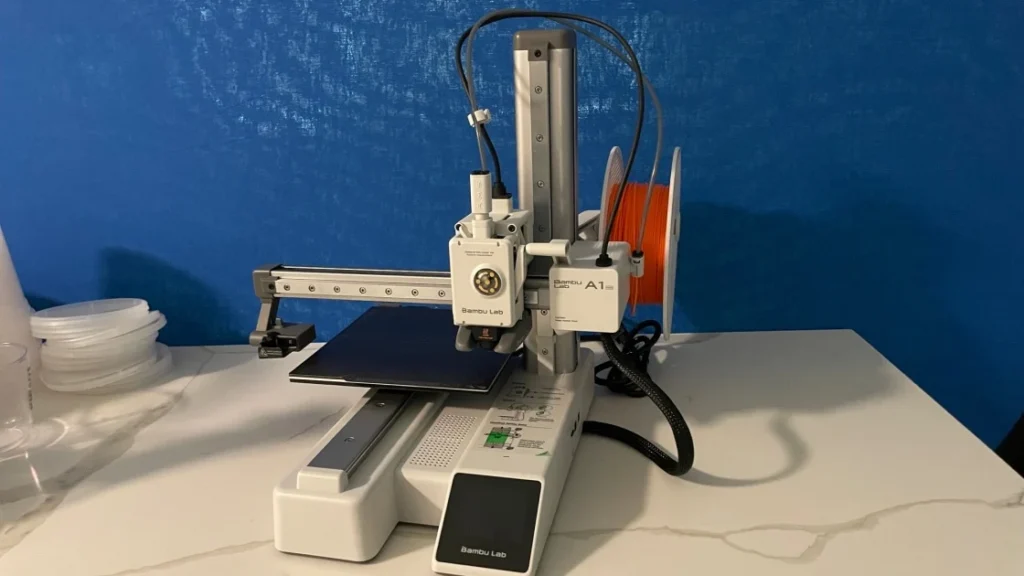
The Bambu Lab A1 Mini is the one FDM printer on our list, and it’s here for a specific reason: resin printers are not the best 3D printer for miniatures when the goal is large-format terrain, dungeon tile sets, or structural gaming accessories.
| Spec | Detail |
|---|---|
| Technology | FDM (Fused Deposition Modeling) |
| Build Volume | 180 × 180 × 180 mm |
| Layer Resolution | 50–350 microns |
| Print Speed | Up to 500 mm/s |
| Price Range | ~$300–$360 |
The A1 Mini prints at up to 500 mm/s, completing a full dungeon floor tile (150 × 150 mm) in approximately 45 minutes. Multi-color printing via the AMS Lite system supports up to 4 filament colors simultaneously, useful for terrain pieces with stone walls, dirt floors, and wooden accents in a single print.
FDM layer lines are visible on smooth surfaces at 28mm figure scale, which is why we don’t recommend it for character miniatures. But for cobblestone streets, modular castle walls, or 54mm–90mm scale statues, the surface texture from FDM actually enhances the final painted result.
The A1 Mini pairs well with any resin printer on this list. Use resin for figures: use the A1 Mini for everything that surrounds them on the table.
6. Anycubic Photon M3 Max: Best Large-Format Resin Printer for Epic Terrain
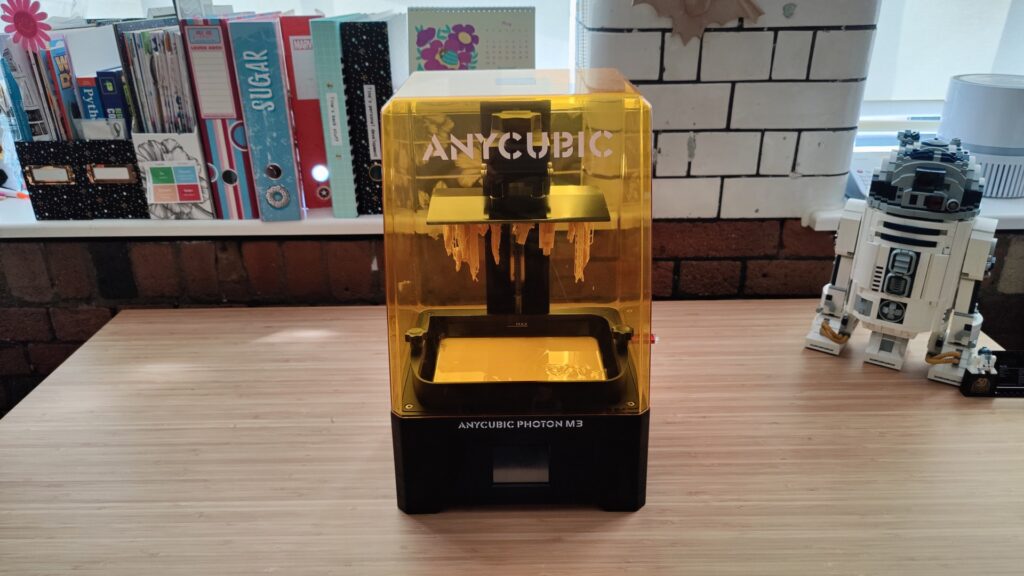
The Anycubic Photon M3 Max is the largest resin printer on our list, with a 298 × 164 × 300 mm build volume, nearly 3× the volume of the Mars 5 Ultra. This makes it the best 3D printer for miniatures and terrain users who work at large scale without switching to FDM.
| Spec | Detail |
|---|---|
| Resolution | 7K mono LCD |
| Build Volume | 298 × 164 × 300 mm |
| XY Accuracy | 43 microns |
| Print Speed | Up to 80 mm/h |
| Price Range | ~$550–$620 |
The 7K resolution at 43 microns XY is a trade-off: you gain massive build area but lose some fine detail compared to 8K or 12K competitors. At 28mm scale, faces and fine weapon details are still sharp. At 54mm scale and above, the quality difference between 43-micron and 22-micron resolution is negligible to the naked eye.
The M3 Max is ideal for:
- Dungeon masters printing full room-scale terrain sets in resin
- Makers producing large display pieces (dragons, giants, large monsters)
- Studios batch-printing resin terrain kits for sale or commission
Resin consumption is significant at this size, a full build plate print at 200 mm height uses approximately 1.8 liters of resin. Budget for resin costs accordingly.
7. Formlabs Form 4: Best Professional-Grade Printer for Studio-Quality Miniatures
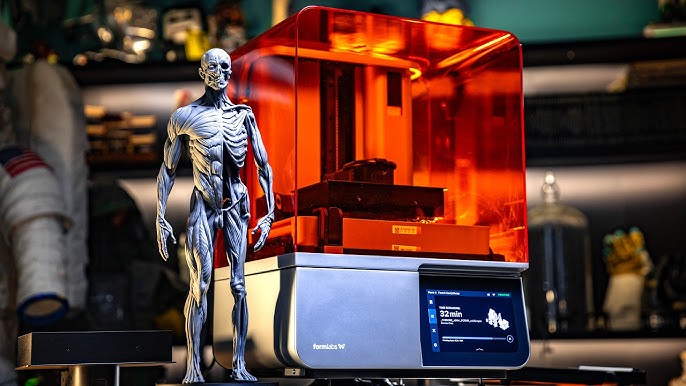
The Formlabs Form 4 is the premium option on this list, and the most expensive, but it sets a quality standard that no other printer here matches. It uses Low Force Display (LFD) technology rather than standard MSLA, producing isotropic parts with consistent mechanical properties in all directions.
| Spec | Detail |
|---|---|
| Technology | LFD (MSLA variant) |
| Build Volume | 200 × 125 × 210 mm |
| XY Accuracy | 50 microns |
| Print Speed | Up to 100 mm/h |
| Price Range | ~$3,499+ |
At 50 microns XY, the Form 4 doesn’t win on raw pixel density versus the Sonic Mighty 8K or Mars 5 Ultra. What it wins on is surface isotropy and material range. Formlabs offers over 40 validated resins, including flexible, castable, and engineering-grade materials.
For professional miniature sculptors who produce masters for casting, or studios that sell resin-cast figures commercially, the Form 4 provides the surface finish and material accuracy required. A single Form 4 print of a 75mm display bust shows zero visible layer lines at 0.025 mm layer height.
The Formlabs ecosystem includes PreForm slicer software, which automates support placement with near-zero user adjustment, saving approximately 3 hours per week for full-time studio users. The Form 4 is not a starter 3D printer for miniatures, but for professionals who treat printing as a business tool, it justifies every dollar.
How to Choose the Best 3D Printer for Miniatures
Selecting the right 3D printer for miniatures comes down to five core factors. Here’s how to match each factor to your actual needs:
1. Resolution (XY Accuracy)
For 28mm miniatures, aim for 25 microns or finer. At this level, chainmail, facial features, and weapon details resolve cleanly. Printers above 40 microns show visible stepping on small figures at normal viewing distance.
| Resolution Tier | Best For |
|---|---|
| 18–25 microns | Competition painting, display pieces |
| 26–35 microns | Standard tabletop gaming figures |
| 36–50 microns | Large figures (54mm+), terrain |
| 50+ microns | FDM terrain, structural models |
2. Build Volume
Larger isn’t always better. Compact printers like the Mars 5 Ultra are faster to fill and consume less resin per run. Match build volume to your typical session output:
- 10–20 minis per session → Mid-size printer (Saturn 4 Ultra, Sonic Mighty 8K)
- 1–5 minis per session → Compact printer (Mars 5 Ultra, Photon Mono M7 Pro)
- Large terrain pieces → Large-format printer (Photon M3 Max) or FDM (A1 Mini)
3. Budget
| Budget Range | Recommended Printer |
|---|---|
| Under $300 | Anycubic Photon Mono M7 Pro |
| $300–$500 | Elegoo Mars 5 Ultra, Saturn 4 Ultra |
| $400–$650 | Phrozen Sonic Mighty 8K, Photon M3 Max |
| $3,000+ | Formlabs Form 4 |
4. Skill Level
Beginners should prioritize auto-leveling, user-friendly slicer software, and an active community (Elegoo and Anycubic both have large forums). Intermediate and advanced users can look at machines with more manual control and expanded material compatibility.
5. Resin vs. FDM
Choose resin for any figure under 80mm where surface quality matters. Choose FDM for large terrain, structural gaming pieces, or when you want to avoid resin handling entirely. Most serious hobbyists eventually run both technologies side by side.
Quick Comparison Table:
| Printer | Resolution | Build Volume | Price | Best For |
|---|---|---|---|---|
| Elegoo Saturn 4 Ultra | 12K (19×24µm) | 218×123×220 mm | ~$470 | Overall best |
| Anycubic Photon Mono M7 Pro | 12K (19×24µm) | 196×122×200 mm | ~$270 | Beginners |
| Phrozen Sonic Mighty 8K | 8K (22×25µm) | 218×123×235 mm | ~$420 | Competitive painters |
| Elegoo Mars 5 Ultra | 12K (18×24µm) | 153×78×165 mm | ~$220 | Compact spaces |
| Bambu Lab A1 Mini | FDM (50–350µm) | 180×180×180 mm | ~$330 | Terrain/FDM |
| Anycubic Photon M3 Max | 7K (43µm) | 298×164×300 mm | ~$580 | Large-format resin |
| Formlabs Form 4 | LFD (50µm) | 200×125×210 mm | ~$3,499 | Professional studios |
The best 3D printer for miniatures is eventually the one that matches your scale, session size, and budget, not simply the highest-resolution machine available. Start with your most common print size and work outward from there.
Frequently Asked Questions About 3D Printers for Miniatures
What is the best 3D printer for miniatures at the beginner level?
The Anycubic Photon Mono M7 Pro is the best beginner 3D printer for miniatures, offering 12K resolution at under $300 with auto-leveling and a starter resin kit. It delivers clean facial features and weapon details for 28mm figures without requiring advanced setup knowledge.
How much resolution do I need for a quality miniature 3D printer?
For 28mm tabletop miniatures, aim for 25 microns or finer XY accuracy to resolve chainmail, facial features, and weapon details cleanly. Printers above 40 microns show visible stepping on small figures. At 54mm+ scale, 35–43 microns is acceptable.
Can FDM 3D printers produce quality miniatures?
FDM printers can produce quality miniatures at 54mm scale and above, but layer lines remain visible at 28mm without heavy post-processing. Resin is the standard for tabletop-quality detail at small scales; use FDM for terrain, dungeons, and large structural models instead.
What is the difference between a compact and large-format miniature 3D printer?
Compact printers like the Mars 5 Ultra fit small spaces and are faster to fill, consuming less resin per run—ideal for 1–5 minis per session. Large-format printers like the Photon M3 Max handle 10–20+ minis and terrain in one batch, but require more space and resin investment.
Do I need a wash and cure station for resin miniature 3D printing?
Yes. Every resin 3D printer for miniatures requires post-processing: washing uncured resin off the print, then UV curing it fully. A dedicated wash-and-cure station takes approximately 15 minutes per batch and significantly improves final surface hardness and detail.
What resin type works best for gaming miniatures?
ABS-like or water-washable resins strike the best balance between durability and detail for gaming miniatures. Standard resins are brittle and prone to snapping at thin parts like spears and antennae. ABS-like resins flex slightly before breaking, protecting handled gaming pieces.