
Planning a content strategy without data is essentially guesswork. That’s where an SEO forecasting tool becomes invaluable it transforms raw keyword data, historical trends, and competitive insights into actionable traffic predictions that guide smarter marketing decisions.
Whether you’re pitching an SEO budget to stakeholders, planning a content calendar, or evaluating the ROI of a link-building campaign, forecasting organic traffic growth gives you a structured way to set realistic expectations and measure success. This guide covers what SEO forecasting tools do, how to use them effectively, which platforms are worth your attention, and how to build forecasts that hold up under scrutiny.
What Is an SEO Forecasting Tool?
An SEO forecasting tool is software or a methodology that estimates future organic traffic based on variables such as keyword search volume, current rankings, click-through rates (CTR), seasonality, and competitive landscape. Rather than relying on gut instinct, these tools use statistical modeling and historical performance data to project what organic traffic could look like over a defined time period typically 6 to 24 months.
These tools are used by:
- In-house SEO teams to justify headcount and tooling budgets
- SEO agencies to set client expectations and demonstrate projected value
- Content strategists to prioritize high-impact topics
- C-suite and marketing directors to align SEO goals with revenue targets
Why SEO Traffic Forecasting Matters
Organic search is a long-term channel. Unlike paid ads, results from SEO efforts may take months to materialize. This delay makes forecasting critical it bridges the gap between present-day activity and future outcomes.
Aligning SEO with Business Goals
Without forecasts, SEO exists in isolation. A well-built forecast connects keyword rankings to estimated traffic, and traffic to conversion and revenue estimates. This alignment generally makes it easier to secure budget approvals and demonstrate the business case for SEO investment.
Setting Realistic Expectations
One of the most common sources of friction between SEO teams and leadership is misaligned expectations. Forecasting tools help establish a shared understanding of what is achievable within a given timeframe, typically reducing conflicts caused by unrealistic timelines.
Identifying High-Value Opportunities
By modeling different keyword scenarios, an SEO forecasting tool can help surface which content investments are likely to generate the most traffic and revenue allowing teams to prioritize accordingly.
How SEO Forecasting Tool Work?
Most SEO forecasting tools rely on a core set of inputs and calculations. Understanding the underlying logic helps you build more accurate forecasts and interpret results with the right level of confidence.
Core Inputs Used in SEO Forecasting
- Keyword Search Volume Monthly search volume data (typically pulled from Google Search Console, Ahrefs, SEMrush, or Moz) forms the baseline. These numbers represent how many times a query is searched per month on average.
- Click-Through Rate (CTR) Curves Not every search results in a click. CTR varies significantly based on position. Position 1 typically captures between 25–35% of clicks for informational queries, while position 10 may capture less than 2–3%. Most tools use industry-standard CTR curves, though these can vary by query type (branded vs. non-branded, featured snippets, etc.).
- Current Rankings Your existing rank for a keyword determines the starting point. Tools measure the gap between your current position and a target position to estimate the traffic uplift.
- Seasonality and Trends Some tools integrate Google Trends data or historical search volume patterns to account for seasonal fluctuations — important for industries like e-commerce, travel, or tax services where demand peaks at specific times of year.
- Ranking Velocity More advanced tools attempt to model how quickly a page is likely to move from its current position to a target position, based on domain authority, content quality signals, and historical movement.
Types of SEO Forecasting Models
There is no single universally accepted method for SEO forecasting. Several approaches are commonly used, each with its own trade-offs.
1. Keyword-Level Traffic Forecasting
This is the most granular approach. You estimate traffic for each individual keyword by multiplying its search volume by the expected CTR at your target ranking position.
Formula: Projected Traffic = Search Volume × Expected CTR at Target Position
For example, if a keyword has 5,000 monthly searches and you expect to rank in position 3 (CTR ~10%), the projected monthly traffic would be approximately 500 visits.
This method works well for targeted campaigns but can become complex at scale when dealing with hundreds or thousands of keywords.
2. Category or Topic-Level Forecasting
Rather than forecasting keyword by keyword, this model groups keywords into topical clusters and forecasts traffic at the cluster level. It is generally more manageable for large content programs and aligns better with how search engines evaluate topical authority.
3. Historical Trend Extrapolation
This approach analyzes your site’s historical organic traffic growth rate and extrapolates it forward. While simpler to execute, it is more reliable for established sites with consistent growth patterns and less useful for new sites or those undergoing significant strategy changes.
4. Scenario-Based Forecasting
Rather than producing a single estimate, scenario-based models generate a range of outcomes — typically a conservative, base case, and optimistic scenario. This is particularly valuable for stakeholder communication, as it sets honest expectations and accounts for the inherent uncertainty in SEO.
Best SEO Forecasting Tools Available Today
Several platforms offer built-in forecasting capabilities or can be used to build custom forecasts. Each has strengths depending on your use case, team size, and technical comfort level.
Ahrefs
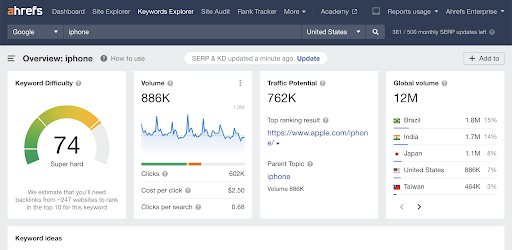
Ahrefs provides keyword search volume data, traffic potential estimates, and keyword difficulty scores that form the foundation of most forecasting workflows. While it does not offer a dedicated forecast feature per se, its Traffic Potential metric estimates the total traffic a page could receive if it ranked at the top for its primary keyword, accounting for all related queries.
Best for: Keyword research, competitive gap analysis, and building manual forecasts.
SEMrush
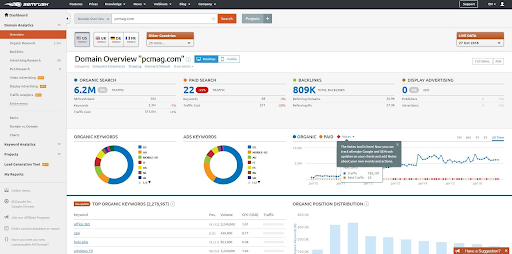
SEMrush includes a Keyword Manager and Position Tracking tool that can be used to monitor ranking changes over time. Its forecasting is largely manual, but it integrates well with custom spreadsheet modeling. The platform also provides competitive traffic share data useful for benchmarking projections.
Best for: Tracking rank movement over time and competitive benchmarking.
Google Search Console
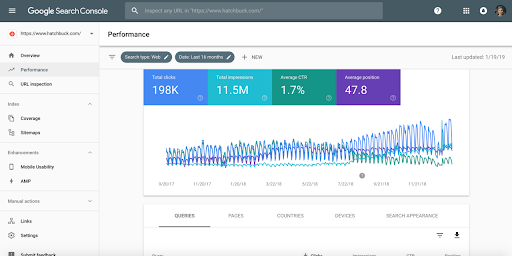
GSC is the most reliable source of actual performance data for your own site. While it does not offer forecasting natively, it provides the historical impressions, clicks, and CTR data that power accurate, data-driven models. Many SEO forecasts are built by exporting GSC data into spreadsheets or BI tools.
Best for: Baseline data accuracy and real-world CTR benchmarking.
Google Keyword Planner
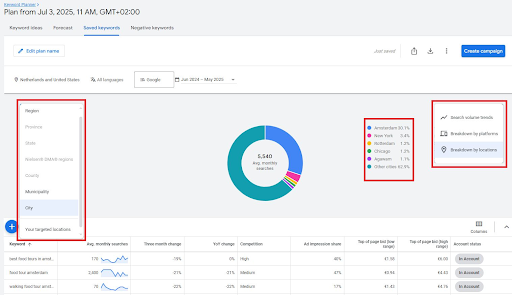
Primarily designed for paid search, Google Keyword Planner still provides useful search volume ranges and forecast data. It is free and integrates directly with Google Ads data, making it a reasonable starting point for early-stage forecasting.
Best for: Budget-conscious teams and supplementary volume validation.
Moz Pro
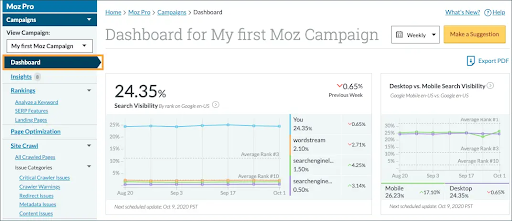
Moz offers keyword research, domain authority metrics, and rank tracking that support manual forecasting workflows. It is generally considered more accessible for beginners and provides useful competitive context. For teams comparing tools like Ahrefs vs Moz, the choice often comes down to depth of data versus ease of use in day-to-day SEO workflows.
Best for: Smaller teams and agencies looking for an accessible research-to-forecast workflow.
Forecast Forge (Google Sheets Add-on)
Forecast Forge applies machine learning-based time series forecasting directly within Google Sheets using historical traffic data. It is particularly useful for extrapolation-based forecasting and scenario modeling without requiring data science expertise.
Best for: Technical SEOs and analysts comfortable working in spreadsheet environments.
Custom Models in Google Sheets or Excel
Many experienced SEO professionals prefer building their own forecasting models in spreadsheets. This approach offers maximum flexibility and transparency — you control every assumption. A typical model pulls keyword data from Ahrefs or SEMrush, applies CTR curves, accounts for seasonality, and generates a traffic projection by month.
Best for: Agencies and enterprise teams that need customized, client-specific models.
Step-by-Step: How to Build an SEO Traffic Forecast
Here is a practical, repeatable process for building a keyword-level SEO forecast.
Step 1 – Define the Scope and Time Horizon
Decide what you are forecasting: a single page, a content category, or your entire organic channel. Set a realistic time horizon — 6 months is typically achievable for tactical forecasts; 12–24 months for strategic planning.
Step 2 – Pull Your Keyword Data
Export a list of target keywords from your SEO tool of choice. For each keyword, capture:
- Monthly search volume
- Current ranking position
- Keyword difficulty
- Target ranking position (your goal)
Step 3 – Apply CTR Estimates
Use a CTR curve appropriate for your industry and query type. A standard reference is the Advanced Web Ranking CTR study, which publishes position-by-position click-through rates segmented by device and query type. Apply the CTR corresponding to your target position to each keyword.
Step 4 – Calculate Projected Traffic
Multiply the search volume of each keyword by the expected CTR at your target position. Sum these across all keywords to get a total monthly traffic estimate for the target period.
Step 5 – Adjust for Seasonality
Check Google Trends or historical GSC data for seasonal patterns. Apply multipliers to months where search demand typically peaks or dips.
Step 6 – Build Scenarios
Create at least three versions of your forecast:
- Conservative: Assumes modest ranking improvements, lower CTRs
- Base case: Assumes expected performance based on current trajectory
- Optimistic: Assumes strong execution and favorable competitive conditions
Step 7 – Model Revenue Impact (Optional but Valuable)
If conversion rate and average order value or lead value are known, extend the forecast to estimate revenue. This step is especially important when presenting forecasts to non-SEO stakeholders.
Projected Revenue = Projected Traffic × Conversion Rate × Average Value
Common Mistakes to Avoid in SEO Forecasting
Even experienced practitioners make predictable errors when forecasting organic traffic. Being aware of these pitfalls generally improves forecast accuracy.
Over-Relying on Search Volume Alone
Search volume is a useful proxy but not a reliable measure of actual traffic opportunity. Featured snippets, zero-click searches, and SERP features like People Also Ask boxes may significantly reduce the clicks available even for a top-ranking page.
Ignoring Ranking Volatility
SEO rankings are not static. Algorithm updates, new competitors, or shifts in search intent can displace previously stable rankings. Forecasts that assume linear progression from current to target position tend to underestimate risk.
Using Generic CTR Curves
Industry-average CTR data may not reflect your specific niche, audience, or SERP environment. When possible, use your own historical CTR data from Google Search Console rather than published benchmarks.
Neglecting Cannibalization
If multiple pages on your site target overlapping keywords, forecasting them independently may result in double-counting traffic. Audit for keyword cannibalization before building granular forecasts.
Not Revisiting Forecasts
A forecast is not a set-and-forget document. Building in a regular review cadence typically monthly or quarterly allows you to adjust assumptions as real performance data comes in.
How to Present SEO Forecasts to Stakeholders
The technical accuracy of a forecast matters little if it fails to communicate clearly to decision-makers. Here are principles for presenting SEO forecasts effectively.
Lead with Business Outcomes
Stakeholders typically care more about revenue and leads than rankings or impressions. Where possible, translate traffic projections into business metrics using your site’s conversion data.
Use Ranges, Not Point Estimates
Presenting a single number implies a precision that SEO forecasting cannot deliver. Using ranges such as “between 8,000 and 14,000 monthly visits by Q3” is both more accurate and more credible.
Explain Your Assumptions Clearly
A forecast is only as reliable as its assumptions. Document and communicate your CTR model, the data sources used, and the conditions under which the forecast might diverge from actual results.
Compare Against Benchmarks
Showing how your forecast compares to current performance or industry benchmarks provides useful context. For example, noting that a projected 30% traffic increase aligns with the site’s historical 6-month growth rate adds credibility.
Integrating SEO Forecasts into Broader Marketing Planning
An SEO forecasting tool is most powerful when it connects to broader marketing and business planning, not when it exists in isolation.
Connecting SEO to Content Roadmaps
Forecasts help prioritize which content to create first. Topics with high projected traffic, strong commercial intent, and achievable ranking potential should typically be prioritized over lower-impact opportunities.
Informing Budget and Resource Allocation
If a forecast projects significant traffic growth from a new content cluster, it may justify hiring additional writers, investing in technical SEO improvements, or increasing link-building outreach. Without a forecast, these decisions are harder to justify quantitatively.
Supporting Paid Search Strategy
SEO and PPC teams often compete for the same keywords. Sharing organic traffic forecasts with paid search teams helps identify where organic coverage is growing, potentially allowing for budget reallocation toward less-covered terms.
Conclusion
An SEO forecasting tool is not a crystal ball no tool can predict organic traffic with perfect accuracy. But used thoughtfully, forecasting transforms SEO from a reactive discipline into a proactive, strategically aligned function. By combining reliable data sources, realistic assumptions, and scenario-based modeling, you can build forecasts that are genuinely useful for planning, budgeting, and stakeholder communication.
The most effective forecasts are built on clean data, regularly revisited as real performance data accumulates, and communicated in terms that resonate with business decision-makers. Whether you use a dedicated platform like Ahrefs or SEMrush, or build a custom model in Google Sheets, the underlying discipline remains the same: turn uncertainty into structured, defensible estimates that guide smarter SEO decisions.