Choosing the right SEO platform can significantly influence how efficiently you research keywords, monitor backlinks, audit your site, and track rankings. Two tools consistently appear at the top of this conversation: Serpstat vs Ahrefs.
Ahrefs has long been regarded as an industry benchmark, particularly for backlink intelligence and depth of data. Serpstat, on the other hand, positions itself as a versatile, budget-friendly alternative that combines SEO and PPC analysis in one platform.
This guide provides a detailed, side-by-side comparison of both tools across the areas that matter most to SEO professionals, marketers, and agencies. The goal is to help you make a well-informed decision rather than a default one.
Serpstat vs Ahrefs at a Glance
When comparing SEO tools, both Serpstat and Ahrefs frequently appear among the top choices for marketers, agencies, and businesses aiming to improve their search visibility. While both platforms offer powerful features for keyword research, backlink analysis, and site auditing, they differ in data depth, pricing structure, and overall workflow experience. This quick overview highlights the key differences to help you understand which tool best aligns with your SEO goals.
What Is Serpstat?
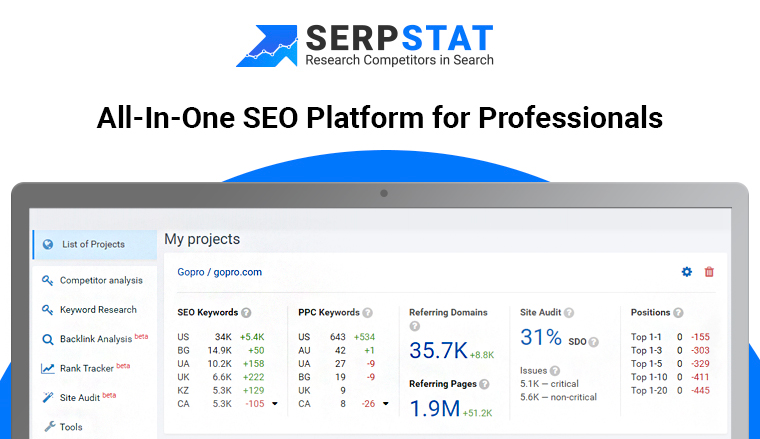
Serpstat is an all-in-one digital marketing platform founded in 2013 and headquartered in Ukraine. Originally conceived as a keyword research tool, it has since expanded into a comprehensive suite covering SEO, PPC, site audits, backlink analysis, and rank tracking. Serpstat is trusted by companies including Lenovo and Shopify, and it serves both individual marketers and large enterprise teams.
What Is Ahrefs?

Ahrefs was founded in 2010 and is based in Singapore. It began as a backlink checker and has grown into one of the most widely referenced all-in-one SEO platforms in the industry. Ahrefs operates one of the world’s most active web crawlers, second only to Google, providing near-real-time data on backlinks, keywords, and content. It is particularly well regarded by agencies and experienced SEO professionals who need high data fidelity.
Keyword Research with Serpstat vs Ahrefs
Choosing the right keyword research tool can significantly impact your SEO performance. Both Serpstat and Ahrefs offer extensive keyword databases, competitive metrics, and advanced insights that help marketers uncover search trends and identify ranking opportunities faster.
Serpstat
Serpstat’s keyword research tool draws from a database of 7 billion+ keywords across 230 Google regional databases. It provides the standard metrics: search volume, keyword difficulty, CPC estimates, and trend data. One of its standout features is native keyword clustering, which automatically groups semantically related keywords into topic clusters. This is particularly useful for content planning and building topical authority on a website.
Serpstat also integrates PPC keyword data alongside organic metrics, making it a practical choice for teams managing both paid and organic campaigns from a single platform. Batch analysis lets users evaluate multiple keywords or domains simultaneously using up to 18 metrics.
Ahrefs
Ahrefs’ Keywords Explorer is built on a database of 10+ billion keywords (over 110 billion discovered) spanning Google, YouTube, Amazon, Bing, and other search engines. Beyond basic volume and difficulty scores, Ahrefs provides click-through rate (CTR) estimates, traffic potential forecasts, keyword intent classification, and SERP feature tracking. These predictive metrics are particularly valuable for long-term strategy planning and SEO Forecasting, helping marketers estimate future traffic potential and prioritize keywords with sustainable growth opportunities.
Keyword clustering is available from the Standard plan upward, alongside features such as Content Gap analysis, which identifies keywords competitors rank for that your site does not. For marketers who need deep, granular keyword intelligence and broad database coverage, Ahrefs generally offers a more comprehensive feature set.
| Key Insight: Keyword Research |
| Serpstat’s native clustering and built-in PPC data make it well-suited for content teams and hybrid SEO/PPC workflows. |
| Ahrefs offers a larger keyword database with richer metrics, making it preferable for competitive research at scale. |
| Both tools support multiple search engines, though Ahrefs covers a wider range. |
Backlink Analysis
In the Serpstat vs Ahrefs comparison, backlink analysis is often one of the most decisive factors for SEO professionals. Both tools provide valuable insights into referring domains, anchor text distribution, and link growth trends, but they differ significantly in database size, update frequency, and depth of historical data. Understanding how each platform approaches backlink intelligence can help you choose the right tool for competitive link research and long-term SEO strategy
Serpstat
Serpstat’s backlink module covers referring domains, anchor text distribution, new and lost backlinks, and toxic link detection. The toxic link feature helps identify harmful backlinks that may negatively affect search rankings. Serpstat also offers a link intersection tool for comparing backlink profiles across multiple domains.
However, Serpstat’s backlink index of approximately 1.8 billion backlinks is considerably smaller than Ahrefs’, and the data typically refreshes every 2 to 4 weeks. This means that some newly acquired or recently lost links may not appear in reports immediately.
Ahrefs
Backlink analysis is where Ahrefs has consistently set the industry standard. Its index spans over 200 trillion backlinks and updates at near-real time, typically within 15 to 30 minutes of discovery. Ahrefs’ Site Explorer provides detailed metrics, including Domain Rating (DR) and URL Rating (UR), which have become widely accepted benchmarks across the SEO industry.
Content Explorer, available on Standard plans and above, helps users identify link-building opportunities by surfacing high-authority content in any niche. Ahrefs also tracks historical backlink data going back years, which is valuable for understanding a domain’s link profile trajectory.
| Criterion | Serpstat | Ahrefs |
| Backlink Index Size | ~1.8 billion | 200+ trillion |
| Update Frequency | Every 2–4 weeks | 15–30 minutes |
| Toxic Link Detection | Yes | No native toxic detection |
| Historical Data | Limited | Up to 7 years (Advanced plan) |
| Domain Metrics | Proprietary domain score | DR & UR (industry standard) |
| Link Intersection Tool | Yes | Via Competitive Analysis |
* Ahrefs DR and UR are widely used by the SEO community as benchmark link authority metrics.
Site Audit with Serpstat vs Ahrefs
When comparing site audit capabilities in Serpstat vs Ahrefs, both tools offer powerful ways to identify technical SEO issues and improve overall website health. Understanding how Serpstat and Ahrefs handle crawl diagnostics, error detection, and actionable recommendations can help you choose the right platform for maintaining a well-optimized site and improving search performance.
Serpstat
Serpstat’s site audit tool is highly customizable and offers a broad range of technical checks, including broken links, duplicate content, crawl errors, page speed issues, and on-page SEO recommendations. Users can schedule audits and receive actionable suggestions for fixing detected issues. The audit reports are detailed and generally considered accessible to users with varying levels of technical expertise.
Ahrefs
Ahrefs’ Site Audit is a cloud-based tool that scans websites for 170+ on-page and technical SEO issues, including broken internal links, missing meta tags, slow-loading pages, hreflang errors, and duplicate content. Ahrefs uses a health score system to provide an at-a-glance view of site health, and the visual data representations make it straightforward to prioritize fixes.
Crawl credits are used on lower plans, which may restrict how frequently large sites can be audited. Higher-tier plans remove these restrictions. Ahrefs’ audit tool is well-regarded for its depth and clarity of reporting.
Note: Both platforms provide comprehensive site audit capabilities. Serpstat’s audit is more customizable, while Ahrefs’ is generally regarded as more polished and easier for beginners to use.
Rank Tracking Comparison of Serpstat and Ahrefs
When comparing rank tracking performance, both platforms offer reliable tools for monitoring keyword positions across multiple search engines and devices. However, their approach to tracking frequency, location coverage, and competitor benchmarking differs slightly. Understanding how Serpstat vs ahrefs handle rank tracking can help you choose the platform that best aligns with your SEO monitoring needs, reporting preferences, and campaign scale.
Serpstat
Serpstat’s Rank Tracker monitors keyword positions across Google, Bing, and Yahoo on desktop and mobile devices. It supports local and regional tracking across 230+ Google databases and allows users to compare rankings against competitors. Features include scheduled reports, visibility scoring, and SERP history. The Individual plan includes 10,000 position checks per month, while the Agency plan supports up to 500,000.
Ahrefs
Ahrefs’ Rank Tracker covers 190+ locations and tracks rankings across Google and other search engines on both desktop and mobile. It provides SERP feature tracking (featured snippets, local packs, etc.) and competitor comparison. Daily rank tracking is available as an add-on on some plans. The Starter plan includes 100 tracked keywords, scaling up significantly on higher-tier plans.
Serpstat vs Ahrefs: Competitor Analysis
Both tools offer robust competitor analysis capabilities. Serpstat’s competitive analysis module provides an overview of a competitor’s keyword rankings, paid search data, and backlink profile in a single view. The batch analysis feature enables simultaneous assessment of multiple competitors, which is particularly useful for agencies managing multiple client projects.
Ahrefs’ competitive analysis is built around Site Explorer and Content Gap. Users can identify keyword opportunities their competitors rank for, analyze competitor backlink strategies, and uncover content gaps that represent growth opportunities. For in-depth competitive intelligence, Ahrefs generally provides more data points and greater precision, particularly for backlink-centric competitor research.
Serpstat vs Ahrefs: Pricing Comparison
When comparing Serpstat vs Ahrefs, pricing plays a major role in deciding which platform delivers better long-term value. In this Serpstat vs Ahrefs pricing comparison, the differences become clear across entry-level, mid-tier, and agency plans, especially when considering features like keyword tracking limits, API access, and white-label reporting.
Serpstat Pricing
| Plan | Monthly Price | Key Inclusions |
| Individual | $69/month | Core features, 5 projects, 10,000 position checks |
| Team | $129/month | API, AI Tools, batch analysis, unlimited projects, 50,000 checks |
| Agency | $499/month | White label reports, 500,000 position checks, and data engineer consultation |
Ahrefs Pricing
| Plan | Monthly Price (Annual) | Key Inclusions |
| Webmaster Tools | Free | Site Explorer & Site Audit for verified sites only |
| Starter | $29/month | 1 project, 100 tracked keywords, basic keyword & backlink access |
| Lite | $108/month | 5 projects, 500 credits/month, competitor analysis, MCP access |
| Standard | $208/month | 20 projects, unlimited credits, keyword clustering, Content Explorer |
| Advanced | $374/month | 50 projects, API access, extended historical data |
| Enterprise | $1,249/month | 100 projects, SSO, custom solutions, Fortune 500 focus |
* Ahrefs charges additional fees for extra users ($40–$80/month per user, depending on plan) and for daily rank tracking (add-on). Prices shown are for annual billing; monthly billing is higher.
Serpstat vs Ahrefs: Ease of Use and Interface
Ease of use and interface design play a significant role in determining which platform best suits your workflow. While both tools offer powerful SEO capabilities, their dashboards, navigation, and onboarding experiences differ noticeably. Understanding how Serpstat vs Ahrefs perform in terms of usability can help you choose the platform that matches your experience level, project complexity, and preferred working style.
Serpstat
Serpstat is generally regarded as more accessible for users new to SEO tooling. The dashboard is clean, navigation is intuitive, and most users report being able to generate useful keyword and backlink reports within a short onboarding period. The platform includes training resources and responsive customer support, as highlighted in user reviews.
Ahrefs
Ahrefs has a reputation for a steeper learning curve due to the sheer volume of features and data available across its tools. However, once users become proficient, the level of customization and control is considerably higher than most competing tools. Ahrefs provides extensive documentation, video tutorials, and an active community. For experienced SEO professionals and agencies running complex, multi-client workflows, the investment in learning the interface typically pays off.
| Criterion | Serpstat | Ahrefs |
| Learning Curve | Low – beginner-friendly | Moderate to high – advanced users |
| Dashboard Clarity | Clean, well-organized | Data-dense, highly customizable |
| Training Resources | Tutorials, webinars, and the support team | Extensive docs, videos, and academy |
| Customer Support | Responsive, praised in reviews | Standard support; lower-tier plans are limited |
| Onboarding Speed | Quick – productive in minutes | Longer – requires exploration |
Who Should Use Which Tool?
| User Type | Recommended Tool | Reason |
| Freelancers / Solo SEOs | Serpstat | More affordable, beginner-friendly interface |
| Small Businesses | Serpstat | All-in-one features without the premium price point |
| SEO/PPC Hybrid Teams | Serpstat | Integrated PPC data in one platform |
| Large Agencies | Ahrefs | Greater data depth, scalable for multiple clients |
| In-House SEO Teams (Enterprise) | Ahrefs | Advanced reporting, historical data, API access |
| Backlink-Focused Professionals | Ahrefs | Industry-leading backlink database and metrics |
| Content Marketers | Either | Both offer content gap and keyword cluster tools |
| Budget-Conscious Teams | Serpstat | Broadly 40% cheaper for comparable feature tiers |
Frequently Asked Questions
Serpstat vs Ahrefs: Which is a good alternative?
Yes, Serpstat is a capable alternative to Ahrefs, particularly for users who want a broad feature set at a lower price. While its backlink database is smaller, it offers keyword research, rank tracking, site audits, and PPC analysis in a single platform. For agencies and professionals who rely heavily on backlink intelligence, Ahrefs may still be the stronger choice.
Does Ahrefs offer a free trial in 2026?
Ahrefs does not offer a traditional free trial. However, it offers a free tier called Ahrefs Webmaster Tools (AWT), which gives verified site owners limited access to Site Audit and Site Explorer. A paid Starter plan is available at $29/month for basic access. Serpstat offers a 7-day free trial for its premium features.
Serpstat vs Ahrefs: Which tool is better for backlink analysis?
Ahrefs is widely regarded as the industry standard for backlink analysis. Its index of over 200 trillion backlinks, near-real-time update frequency, and established metrics like Domain Rating (DR) and URL Rating (UR) make it the preferred tool for professionals focused on link building and competitive backlink research.
Which tool is better for beginners?
Serpstat is generally considered easier to use for beginners due to its clean interface and faster onboarding. Ahrefs, while more powerful in some areas, typically takes longer to learn. Both platforms offer training resources to help new users get up to speed.
Can I use both Serpstat and Ahrefs together?
Yes, many agencies and advanced SEO teams use multiple tools to complement each other’s strengths. For example, Ahrefs could be used primarily for backlink research and competitor analysis, while Serpstat handles keyword clustering, PPC data, and rank tracking at a lower cost.
Does Serpstat include PPC data?
Yes. Serpstat integrates organic SEO and paid search (PPC) data into a single platform. This makes it useful for teams managing both channels without needing a separate tool for paid search analysis. Ahrefs offers fewer PPC-specific features than other tools.
Which Ahrefs plan should I start with?
For most independent professionals, the Lite plan ($108/month on annual billing) is generally the most practical starting point. The Starter plan at $29/month is heavily credit-restricted, which limits its utility for regular research tasks. Teams needing keyword clustering or Content Explorer should consider the Standard plan ($208/month).
Conclusion
Both Serpstat and Ahrefs are capable, well-maintained SEO platforms that serve different market segments. When evaluating both, the right choice typically depends on your budget, team size, and the specific SEO tasks you prioritise most. If backlink intelligence, data freshness, and comprehensive competitive analysis are your primary concerns, and your budget can accommodate it, Ahrefs is likely the stronger investment in the Serpstat vs Ahrefs comparison. It has earned its reputation as an industry benchmark for a reason.
If you are looking for a cost-effective, all-in-one solution that covers SEO and PPC analysis, supports native keyword clustering, and is accessible to users at various skill levels, Serpstat offers considerable value in the Serpstat vs Ahrefs debate. For smaller teams and budget-conscious marketers in particular, it typically delivers a strong return on investment. Whichever tool you choose, starting with a trial period, where available, is a practical way to assess whether the platform fits your workflow before committing to an annual subscription.