

If you have called a bank, a hospital, or an online store recently, there is a fair chance the “person” who answered was not a person at all. AI voice agents have quietly crossed the threshold from robotic phone menus to conversations that feel natural enough that many callers never realise they were speaking to software. Understanding how that works is a useful window into how several branches of AI have converged in the last two years.
The three-stage pipeline: hear, think, speak
Every modern voice agent runs a continuous loop of three systems working in sequence, dozens of times per call.
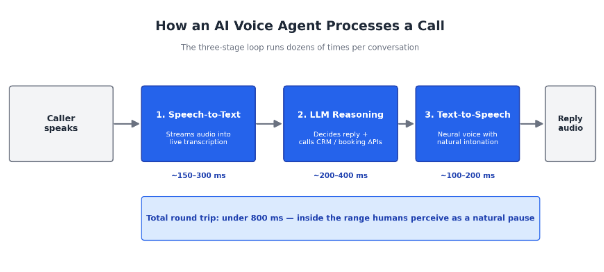
The full loop: transcribe, reason, synthesise — in under a second.
First is speech-to-text (STT), also called automatic speech recognition. The caller’s audio is streamed in small chunks to a model that transcribes it in real time. Modern STT models are trained on hundreds of thousands of hours of audio and can handle accents, background noise, and code-switching between languages mid-sentence, which matters enormously in multilingual markets like India or the UAE.
Second is the reasoning layer, almost always a large language model (LLM). The transcribed text, along with the conversation history and a set of instructions describing the agent’s role, is passed to the LLM, which decides what to say next. Crucially, the LLM can also decide to act: look up an order, check a calendar slot, or write to a CRM through function calls.
Third is text-to-speech (TTS). The LLM’s reply is converted back into audio using a neural voice model. The latest generation of TTS engines produces prosody, pauses, and intonation that track the meaning of the sentence rather than reading it flatly, which is most of what makes the output sound human.
Latency: the hardest problem in the stack
The pipeline above is conceptually simple. What makes voice AI hard is doing it fast. In human conversation, the natural gap between one speaker finishing and the other starting is roughly 200 to 500 milliseconds. If a voice agent takes two seconds to respond, the illusion collapses instantly and callers start saying “hello? hello?” into the silence.
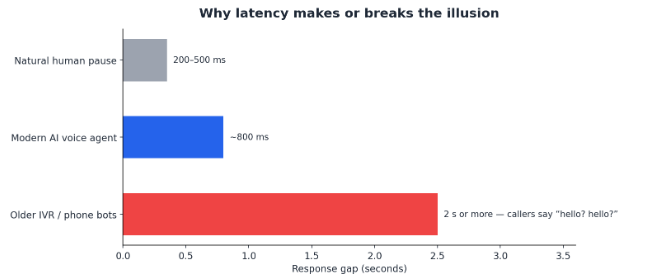
Anything much beyond one second breaks the conversational illusion.
Production systems attack latency at every stage. STT runs in streaming mode, producing partial transcripts before the caller has finished speaking. The LLM begins generating a response the moment an end-of-utterance is detected, and TTS starts synthesising audio from the first few words of the reply while the rest is still being generated. Well-engineered stacks now achieve total round-trip times under 800 milliseconds, which sits comfortably inside the range humans perceive as a normal conversational pause.
Barge-in and turn-taking
Humans interrupt each other constantly, and a voice agent that cannot handle this feels broken. The capability is called barge-in: the system continuously monitors the inbound audio channel even while the agent is speaking, and if the caller starts talking, the agent stops mid-sentence, discards its queued audio, and processes the interruption.
The subtler challenge is deciding when the caller has actually finished a turn. People pause mid-thought, say “umm,” and trail off. Early systems used a fixed silence timeout, which either cut people off or left awkward gaps. Newer systems use semantic endpoint detection, where a small model evaluates whether the utterance so far forms a complete thought before the agent responds.
Connecting the brain to the phone network
A voice agent is useless if it cannot actually pick up the phone. The audio pipeline connects to the public telephone network through SIP trunking or telephony APIs, which handle call routing, transfers to human agents, and recording. On top of that sits the integration layer: the function calls the LLM makes during a conversation need to reach real systems, such as booking software, payment gateways, and customer databases, and return results fast enough to keep the conversation moving.
This orchestration layer is where general-purpose AI models become deployable business tools. Platforms that specialise in AI voice agents for sales and support handle the full stack, from telephony and multilingual speech models to CRM integration, so that a hospital or a lending company can deploy an agent without assembling the pipeline themselves.
What still gives the machines away
For all the progress, careful listeners can still catch a voice agent. Overly consistent politeness, perfectly grammatical sentences, and a slight flatness when handling genuinely unexpected input remain tells. Emotional situations, sarcasm, and heavy crosstalk on a bad line degrade performance in ways they would not for a skilled human agent.
The trajectory is clear, though. Two years ago the state of the art was distinguishable from a human within one exchange. Today it often takes a full conversation. The interesting questions ahead are less about whether the technology can sound human, and more about disclosure norms, caller consent, and which conversations we actually want machines handling in the first place.