
Choosing Ahrefs vs Moz Pro is one of
the most common decisions SEO practitioners face. Both tools have earned strong
reputations over many years, and both cover the core bases: keyword research,
backlink analysis, site auditing, and rank tracking. Yet they differ
meaningfully in database depth, pricing structure, ease of use, and the type of
user each platform is built for.
Here’s the breakdown of every major feature, comparing them side by side with real pricing info and practical insights to help you figure out which tool fits your workflow best. Whether you’re running a solo blog, managing a small agency, or leading an in-house SEO team, the Ahrefs vs Moz comparison here gives a clear, no-nonsense look at what each platform offers.
Tool Overview: What Are Ahrefs and Moz?
When comparing SEO platforms, understanding the strengths and weaknesses of Ahrefs vs Moz is essential for choosing the right tool for your site’s growth and optimization needs.
Ahrefs
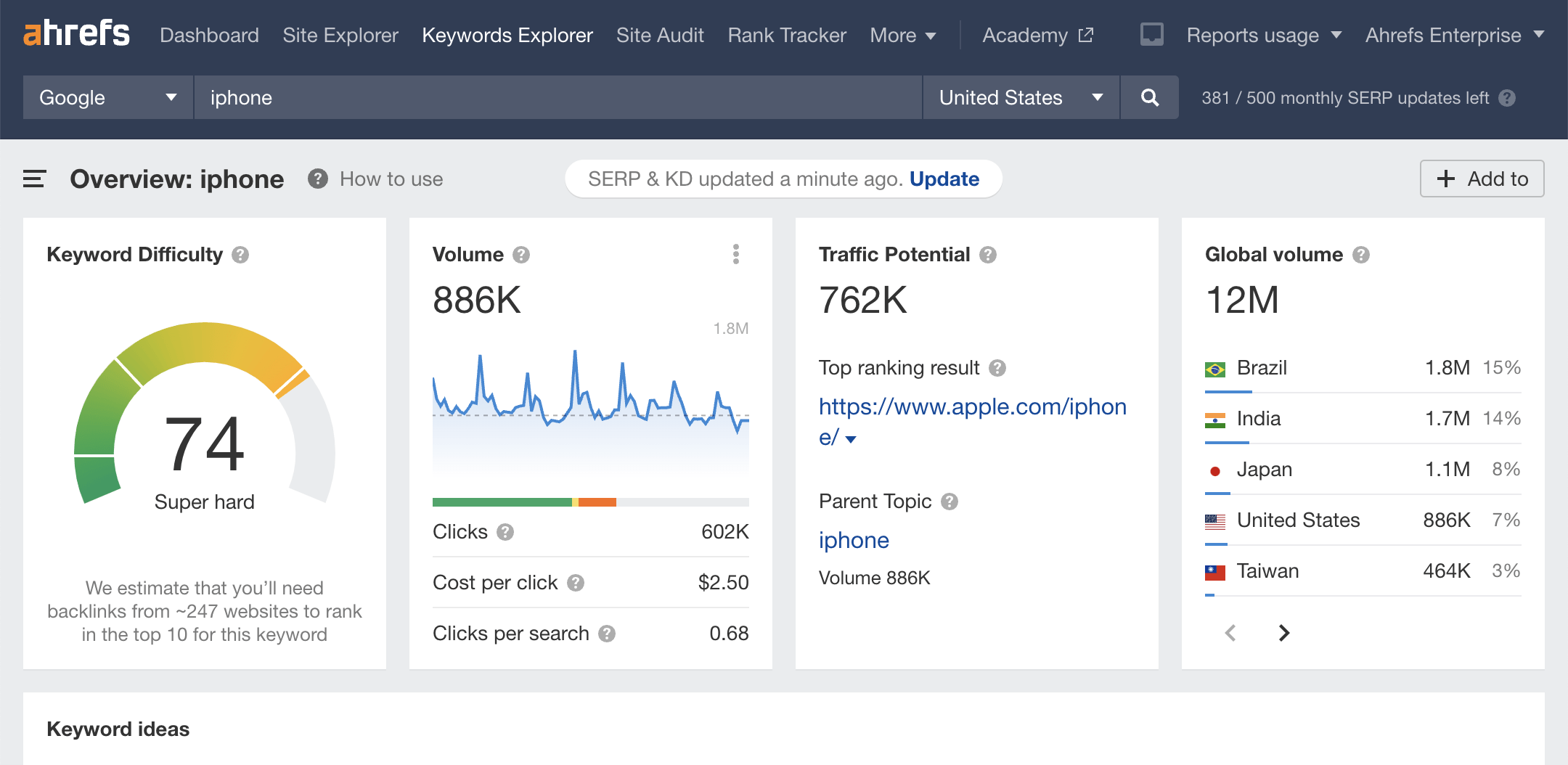
Ahrefs launched in 2011 and was initially built around
backlink analysis. Over time, it expanded into a full SEO platform covering
keyword research (Keywords Explorer), site health (Site Audit), organic rank
monitoring (Rank Tracker), and content discovery (Content Explorer). Its
defining strength is data scale: Ahrefs maintains one of the largest live
backlink indexes available and indexes keywords across Google, YouTube, Amazon,
Bing, and other engines.
Ahrefs also offers Ahrefs Webmaster Tools, a free tier
that gives site owners limited access to Site Explorer and Site Audit. This is
particularly useful for verifying whether the platform meets your needs before
committing to a paid plan.
Moz Pro
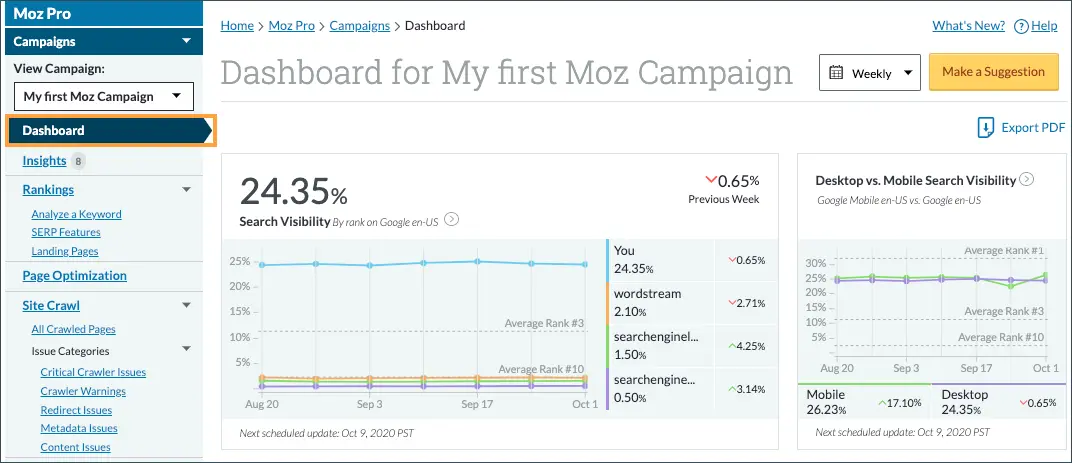
Moz was founded in 2004 and helped shape how the industry
thinks about domain authority. Its proprietary metrics, Domain Authority (DA)
and Page Authority (PA), are still widely used as benchmark signals across the
SEO community. Moz Pro bundles keyword research, site auditing, backlink
analysis, rank tracking, and on-page optimization into a single interface that
prioritises clarity over data volume.
Moz also created the MozBar browser extension, which surfaces
key SEO metrics while browsing any website, and offers Moz Local as a separate
product for businesses managing citations and local listings.
Ahrefs vs Moz Feature-by-Feature Comparison
When it comes to SEO tools, choosing between Ahrefs vs Moz can be challenging, as both offer robust features for keyword research, backlink analysis, and site audits, but differ in depth, coverage, and usability.
Keyword Research
Ahrefs : Keywords Explorer
Ahrefs Keywords Explorer draws from a database reported to
contain billions of keywords across ten-plus search engines. For any seed term,
users can access search volume, keyword difficulty, click-through rate
estimates, traffic potential (volume of the top-ranking page, not just the
keyword), parent topic, and search intent classification. Keyword clustering
and competitive gap analysis are built in. The breadth of engine coverage,
including YouTube and Amazon, makes it particularly useful for content
marketers operating across multiple platforms.
Moz Pro : Keyword Explorer
Moz’s Keyword Explorer provides solid keyword data focused
primarily on Google. It surfaces volume, difficulty, organic click-through
rate, and priority scores that combine multiple signals. The interface is clean
and approachable. Moz tracks around 500 million keywords, which is a much
smaller database than Ahrefs. This means lower-volume keywords, long-tail
queries, and niche or local terms may not appear, or may carry less reliable
volume estimates.
Moz has recently added AI-powered keyword suggestions by topic
and AI Overviews by Keyword tracking, which is a forward-looking addition that
helps users understand how their target queries appear in Google’s AI-generated
results.
|
Attribute |
Ahrefs |
Moz Pro |
|
Keyword database size |
Billions (multi-engine) |
~500 million |
|
Search engines covered |
Google, YouTube, |
Primarily Google |
|
Keyword difficulty |
Yes (with referring |
Yes (combined Priority |
|
Traffic potential |
Yes |
No |
|
Search intent |
Yes |
Limited |
|
AI-powered suggestions |
Yes (updated 2024–2025) |
Yes (Keyword |
|
Long-tail / local |
Strong |
Moderate |
Backlink Analysis
Backlink analysis is often the primary reason users compare
these two tools. Both maintain crawled indexes of the web, though the indexes
differ in size and update frequency.
Ahrefs is widely regarded as having one of the
fastest-updating backlink databases available. It typically surfaces new or
lost links within days of them appearing or disappearing. The platform provides
detailed link-level data including anchor text, link type
(dofollow/nofollow/UGC/sponsored), link position, domain rating of linking domain,
and traffic estimates for referring pages.
Moz reports a link database containing 44.8 trillion links (as
of mid-2025), which is numerically larger than Ahrefs’ reported 35 trillion.
However, raw index size does not always translate directly to useful backlink
data in practice. Independent tests have generally found that Ahrefs surfaces
more referring domains for any given URL, and that its data refreshes more
frequently. Moz’s backlink data tends to be reliable at the domain level but
may miss more granular page-level link signals.
Moz does offer a useful Spam Score metric, which estimates how
likely a linking domain is to be flagged by Google. This can be helpful during
link audits.
|
Attribute |
Ahrefs |
Moz Pro |
|
Index size |
~35 trillion links |
~44.8 trillion links |
|
Update frequency |
Frequently (days) |
Moderate |
|
Referring domain |
Strong (widely tested) |
Good at domain level |
|
Link type |
Dofollow, nofollow, |
Dofollow / nofollow |
|
Spam Score metric |
No |
Yes |
|
Broken link detection |
Yes (Standard plan+) |
Yes |
|
Historical link data |
Up to unlimited |
Included on all plans |
Site Audit
Both platforms crawl websites and report on technical SEO
issues such as broken links, missing meta tags, duplicate content, slow pages,
redirect chains, and crawlability problems.
Ahrefs Site Audit is comprehensive. It generates a site health
score, categorises issues by severity, and provides actionable recommendations.
It supports JavaScript rendering, which is important for modern single-page
applications. Crawl limits vary by pricing plan.
Moz Site Crawl is clean and easy to interpret, making it
well-suited for users who are newer to technical SEO. Reports are
straightforward and prioritised, though the depth of data and crawl volume
available on lower-tier plans is more limited than Ahrefs.
|
Attribute |
Ahrefs |
Moz Pro |
|
JavaScript rendering |
Yes |
Limited |
|
Issue prioritisation |
Yes |
Yes |
|
Crawl volume (entry |
Up to 100K pages/month |
400K pages/month |
|
Health score metric |
Yes |
Yes |
|
Ease of interpretation |
Moderate (data-dense) |
High |
Rank Tracking
Both tools offer rank tracking, though with some differences
in granularity and flexibility.
Ahrefs Rank Tracker allows position monitoring down to
postcode/ZIP level, which is useful for hyper-local campaigns. It also tracks
rankings across multiple search engines and provides SERP feature tracking
(featured snippets, image packs, and so on). However, rank tracking in Ahrefs
uses project slots, which are limited by plan tier.
Moz offers two rank-tracking options: a standard
campaign-based tracker (similar to Ahrefs) and an on-demand rank checker that
does not consume a campaign slot. The on-demand option can be used up to 200
times per day and is useful for quick spot-checks. Moz’s standard rank tracker
monitors down to the city level, which is slightly less granular than Ahrefs’
postcode-level tracking.
Domain Analysis and Authority Metrics
Ahrefs uses Domain Rating (DR) and URL Rating (UR), both of
which are backlink-focused metrics. It also includes an Ahrefs Rank (AR),
traffic value estimates, and organic traffic trend charts showing how the algorithm
changes have affected a domain over time.
Moz uses Domain Authority (DA) and Page Authority (PA). These
metrics are arguably the most widely referenced third-party SEO signals in the
industry, frequently cited in link-building pitches and client reports. Moz
also introduced a Brand Authority Score, which estimates a domain’s overall
online presence beyond just link equity.
Content Research
Ahrefs Content Explorer lets users search across billions of
web pages to find top-performing content on any topic. It is particularly
useful for identifying link-building targets, guest post opportunities, and
content gaps. Users can filter by traffic, referring domains, social shares,
and publication date.
Moz does not offer a dedicated content exploration tool at the
same depth. It provides on-page optimisation suggestions for existing pages but
does not have an equivalent to Ahrefs’ Content Explorer for prospecting and
discovery.
Competitor Analysis
Both tools offer competitive research. Ahrefs allows
side-by-side domain comparisons, keyword gap analysis (identifying keywords
competitors rank for that you do not), backlink intersection analysis, and
organic traffic estimates. The depth of data generally gives Ahrefs an
advantage for detailed competitive intelligence.
Moz provides competitive analysis through its Keyword Explorer
and Link Explorer, allowing users to see what keywords competitors rank for and
which domains link to them. The data is reliable but covers a smaller sample,
which may be sufficient for less competitive niches but can miss signals in
more crowded verticals.
Local SEO
Moz has a stronger native local SEO offering. In addition to
city-level rank tracking, Moz Local (a separate subscription starting at around
$24/month) helps businesses manage and distribute citations across directories,
monitor reviews, and maintain listing accuracy.
Ahrefs does not include a dedicated local SEO or citation
management tool. For local businesses or agencies with local clients, this is a
meaningful gap.
Ahrefs vs Moz Pricing Comparison
Pricing is often the deciding factor, especially for solo bloggers, freelancers, and those managing small business needs. Both platforms use tiered subscription models, with annual billing offering meaningful discounts.”
Ahrefs Pricing
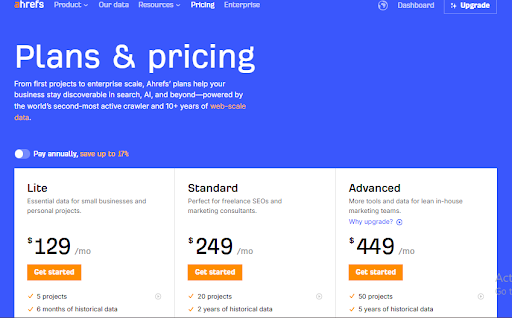
|
Plan |
Monthly |
Annual |
Best |
|
Starter |
$29/mo |
~$29/mo |
Occasional site checks, |
|
Lite |
$129/mo |
~$108/mo |
Solo bloggers, |
|
Standard |
$249/mo |
~$208/mo |
Small agencies, content |
|
Advanced |
$449/mo |
~$374/mo |
Mid-size agencies, |
|
Enterprise |
$1,499/mo |
$14,990/yr |
Large teams, Fortune |
Moz Pro Pricing
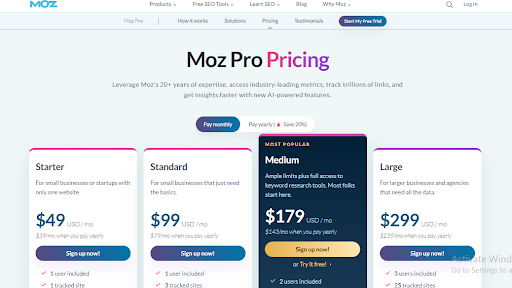
|
Plan |
Monthly |
Annual |
Best |
|
Starter |
$49/mo |
$39/mo |
Individuals, |
|
Standard |
$99/mo |
$79/mo |
Small businesses, |
|
Medium |
$179/mo |
$143/mo |
Growing teams, agencies |
|
Large |
$299/mo |
$239/mo |
Larger agencies, |
|
Premium |
$599/mo |
$479/mo |
Large marketing teams, |
|
Key Pricing Takeaway |
|
At Mid-tier: Ahrefs Moz Ahrefs’ |
Ease of Use and Learning Curve of Ahrefs and Moz
Moz Pro is consistently rated as the more beginner-friendly of
the two platforms. Its interface is clean, and reports are presented in plain
language, and the platform includes a significant library of educational
resources (Moz Academy, Whiteboard Friday video series, and the Moz Blog) that
help newer practitioners develop their skills while using the tool.
Ahrefs is data-dense, which is an advantage for experienced
SEOs but can be overwhelming for those new to the field. Navigation across
tools is generally well-organised, but the volume of filters, metrics, and data
points requires time to master. Ahrefs also maintains an active blog and
YouTube channel with tutorials, though the platform’s depth means the learning
curve is steeper.
|
Dimension |
Ahrefs |
Moz Pro |
|
Interface complexity |
High (data-dense) |
Low to moderate (clean) |
|
Beginner-friendliness |
Moderate |
High |
|
Educational resources |
Blog, YouTube tutorials |
Blog, Academy, |
|
Onboarding experience |
Functional, minimal |
Guided, more |
|
Report readability |
Detailed (can be |
Clear, |
Who Should Use Ahrefs vs Moz?
|
Use |
Recommended |
Reason |
|
Solo bloggers on a |
Moz Pro |
Lower cost, free trial, |
|
Bloggers with |
Ahrefs (Lite/Standard) |
Content Explorer, |
|
Freelance SEO |
Ahrefs (Lite) |
Powerful analysis, |
|
Small agencies (5–10 |
Ahrefs Standard or Moz |
Depends on client needs |
|
Larger agencies |
Ahrefs Advanced |
Multi-site capacity, |
|
Local businesses / |
Moz Pro + Moz Local |
City-level tracking, |
|
Beginners new to SEO |
Moz Pro |
Cleaner reports, 30-day |
|
Link-building |
Ahrefs |
Industry-leading |
|
Technical SEO teams |
Ahrefs |
JavaScript rendering, |
|
Content discovery / |
Ahrefs |
Content Explorer has no |
Ahrefs vs Moz: Strengths and Weaknesses
When comparing SEO tools, Ahrefs vs Moz often comes up as the top debate among marketers looking for accurate backlink data, keyword insights, and content research capabilities.
Ahrefs Strength:
- Extensive, frequently updated backlink database
- Broad keyword coverage across multiple search engines
- Content Explorer for content research and prospecting
- Postcode-level rank tracking granularity
- Includes paid search (PPC) keyword data
- Traffic value and algorithm-impact data in domain analysis
Ahrefs Weakness:
- No free trial; Starter plan is very limited
- Credit-based usage model can limit power users to lower
plans - Steeper learning curve for beginners
- No local SEO or citation management tools
- Additional user seats add cost quickly
Moz Strength:
- Widely trusted Domain Authority (DA) metric
- Beginner-friendly interface and reporting
- 30-day free trial available on Standard and Medium
plans - Spam Score for link audit quality checks
- On-demand rank checker (does not use campaign slots)
- Moz Local integration for local SEO workflows
- AI Overviews tracking by keyword (forward-looking
feature)
Moz Weakness:
- Smaller keyword database (approximately 500 million)
- Primarily Google-focused; limited multi-engine support
- No Content Explorer equivalent
- Backlink data less granular at the page level compared
to Ahrefs - Fewer keyword data points (e.g. no traffic potential
metric)
Frequently Asked Questions
Is Ahrefs better than Moz for backlink analysis?
Generally, yes. Ahrefs is widely regarded as having one of the
most comprehensive and frequently updated backlink databases available. While
Moz reports a larger raw link count, independent comparisons tend to find
Ahrefs more useful in practice for identifying referring domains, tracking link
velocity, and finding new link opportunities.
Does Moz offer a free trial?
Yes. Moz Pro offers a 30-day free trial on its Standard and
Medium monthly plans. Ahrefs does not offer a free trial, though the free
Ahrefs Webmaster Tools provides limited access to Site Explorer and Site Audit
for verified site owners.
Which tool is better for beginners?
Moz Pro is generally considered the more beginner-friendly
option. Its interface is cleaner, its reports use plainer language, and it
offers more guided educational resources. Ahrefs has a steeper learning curve
but is highly powerful once mastered.
Can I use Ahrefs or Moz for local SEO?
Moz is stronger for local SEO. It tracks rankings down to city
level and, with Moz Local, offers citation management and listing monitoring.
Ahrefs supports postcode-level rank tracking but does not include citation
management or a dedicated local SEO module.
Which is more affordable: Ahrefs or Moz?
Moz Pro is typically 25 to 30 percent less expensive at
comparable tiers. The Moz Standard plan starts at $99/month versus Ahrefs Lite
at $129/month. Moz also offers a Starter plan at $49/month, and annual billing
reduces prices on both platforms significantly.
Does Ahrefs or Moz have better keyword research?
Ahrefs generally offers more comprehensive keyword research
due to its larger multi-engine database, traffic potential metric, and keyword
clustering tools. Moz provides solid keyword data for most Google-focused
workflows but may miss lower-volume or niche terms.
Can I use both Ahrefs and Moz together?
Some SEO teams use both tools simultaneously. A common approach
is to use Ahrefs as the primary tool for backlink analysis, keyword research,
and content discovery, while relying on Moz for Domain Authority benchmarking
in outreach and for local SEO with Moz Local. That said, subscribing to both is
a significant budget commitment and may not be necessary for most individuals
or small agencies.
Key Takeaways
|
Summary: Ahrefs vs Moz |
|
1. 2. Moz 3. 4. For 5. For 6. |
Conclusion
Both Ahrefs and Moz Pro are capable, well-established SEO
platforms that serve the same core functions but do so in meaningfully
different ways. Ahrefs tends to be the stronger choice for practitioners who
need deep data, extensive backlink intelligence, and cross-engine keyword
research. Moz Pro tends to be the better fit for those who prioritise a cleaner
workflow, a lower entry price, and tools designed around accessibility rather
than volume.
For most bloggers starting out, Moz Pro’s free trial and lower
pricing make it the lower-risk way to begin. As your site grows and your
keyword and link-building ambitions expand, Ahrefs often becomes the natural
next step. For agencies, the decision typically comes down to client volume and
the specific types of SEO work on your plate: if backlinks and competitive
analysis are central to your service, Ahrefs is generally worth the additional
cost.
If budget allows, a short trial period with Moz (using the
30-day free trial) before committing to a longer subscription is a practical
approach. For Ahrefs, the Webmaster Tools free tier can provide a useful
preview of the platform’s interface and data quality before purchasing a paid
plan.